Net worth & personal profile
Daymond JohnNet Worth
The $350M estimate tested against FUBU’s court record, Bombas dilution, Shark Tank deal data, wife Heather, three daughters and his current ventures.
Daymond John’s exact net worth is not public. Celebrity Net Worth currently estimates $350 million, but it supplies no personal balance sheet and assumes his Bombas position is still 17.5%. Public records instead show the scale of businesses around him—more than $350 million of FUBU wholesale sales in 2001 and $1.3 billion of cumulative Bombas retail sales by 2023—without disclosing his current ownership, distributions, debts or taxes.
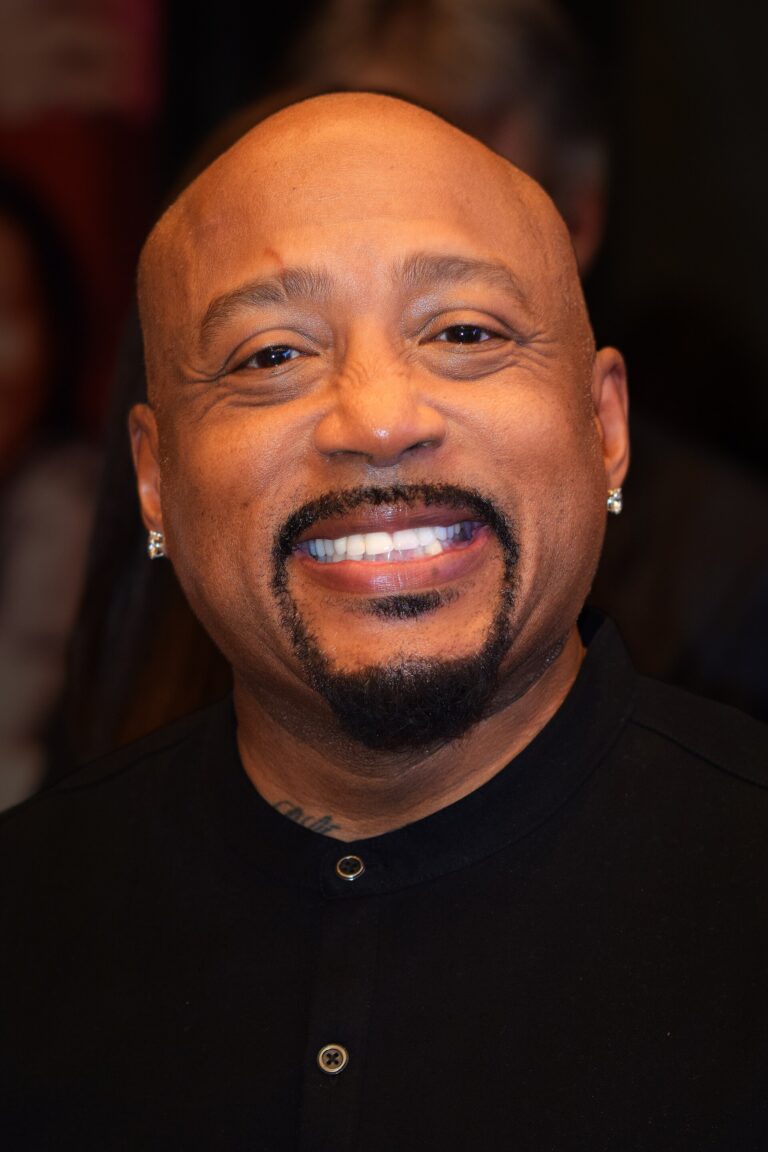
Source · CC BY-SA 4.0 · Displayed crop
The essentials
The $350 million net-worth figure is a third-party estimate without a disclosed asset-and-liability statement. Its claim that John still owns 17.5% of Bombas conflicts with reports of renegotiation and later dilution. [1]
A federal court found that GTFM exceeded $350 million in worldwide wholesale sales in 2001. That is company sales through a multi-party structure, not annual income or personal wealth for John. [2]
FUBU’s “more than $6 billion” figure is cumulative merchandise sold at retail across the brand’s history, including licensed products. It is neither company revenue nor John’s proceeds. [5]
Career · Personal profile · FUBU · Shark Tank · Now
Daymond John’s story attracts unusually large numbers: $350 million of supposed personal wealth, $350 million a year at FUBU and $6 billion in sales. The similarity is misleading. One is an estimate, one is historical wholesale sales and one is cumulative retail sell-through.
This profile uses court findings, network records and company reporting to keep ownership, revenue, retail sales and personal wealth separate. That distinction matters even more for a private investor whose current percentages, distributions and liabilities are mostly undisclosed. Net Worth VIP — methodology
01 / Career
From Hollis to a brand built inside hip-hop
Daymond Garfield John was born in Brooklyn on February 23, 1969, and grew up in Hollis, Queens. He started selling homemade tie-top hats before developing FUBU with Carlton Brown, J. Alexander Martin and Keith Perrin. Celebrity Net Worth — Daymond John · ABC — Daymond John biography
The brand’s breakthrough came from music-culture placement and the financing needed to fill retail orders. The federal record says John sought backing in 1995, then formed GTFM with his partners and Alliance in November 1996; Alliance’s Samsung agreement provided apparel production and sales support. GTFM, Inc. v. Solid Clothing, Inc.
John later rebuilt his public career around investing, books, speaking and television. ABC lists him as an original Shark Tank cast member and continuing CEO of The Shark Group, his private brand-consulting company. ABC — Daymond John biography
02 / Personal profile
Heather, three daughters and life after cancer
John is married to Heather John. His current official site featured Heather and their daughter Minka together at a 2025 family appearance, while his own writing confirms he has three daughters: Destiny, Yasmeen and Minka. Daymond John — family appearance · Daymond John — his three daughters
The children’s book Little Daymond Learns to Earn grew from reading with Minka and John’s wish to teach financial literacy. ABC says the 2023 book became a New York Times bestseller, extending his work from adult business advice to younger readers. ABC — Daymond John biography · Daymond John — his three daughters
John has also spoken publicly about surviving thyroid cancer. His current health project, Shark Gevity, turns that experience into longevity content and products; the business is active, but no public filing discloses revenue, valuation or his economics. Daymond John — current projects
03 / Money evidence
The real $350 million belongs to GTFM in 2001
Celebrity Net Worth estimates John at $350 million. It does not disclose his FUBU equity, Bombas position, investment portfolio, cash, property, debt or taxes, so the number remains an outside estimate rather than a verified personal total. Celebrity Net Worth — Daymond John
The strongest FUBU number comes from federal findings: GTFM’s 2001 worldwide wholesale sales exceeded $350 million, with 2002 projected above $375 million. A separate company history reports $75 million in 1997 and $200 million in 1998. The popular “$350 million at the 1998 peak” line therefore mixes incompatible reports. GTFM, Inc. v. Solid Clothing, Inc. · Smith v. GTFM, Inc. — New York Courts · Reference for Business — FUBU history
Ownership is the missing bridge. John and his partners transferred their FUBU trademark rights to GTFM, which worked with Alliance, Samsung and a master-licensee entity. No public source gives John’s current percentage or personal distributions from that chain. GTFM, Inc. v. Solid Clothing, Inc.
The evidence, with its limits
| Source / measure | Public figure | What it establishes |
|---|---|---|
| Celebrity Net Worth — Daymond John | $350M estimate | Outside personal estimate with no disclosed balance sheet or valuation method. |
| GTFM, Inc. v. Solid Clothing, Inc. | >$350M | GTFM worldwide wholesale sales in 2001; company sales, not John’s income. |
| Reference for Business — FUBU history | $200M | Reported 1998 FUBU wholesale volume; the measure and year differ from the common claim. |
| Licensing International — FUBU master licence | >$6B | Cumulative FUBU-branded merchandise sold at retail; not annual revenue or personal proceeds. |
| Forbes — Shark Tank’s biggest successes | $200K / 17.5% | Televised Bombas deal; later terms and current percentage are not the same. |
| Entrepreneur — Bombas and Daymond John | >$1.3B | Bombas cumulative retail sales by October 2023; not company valuation or John’s stake value. |
| Forbes — what happens after Shark Tank | 56% | Closure rate for John in Forbes’s responding-business sample; not a return or portfolio value. |
04 / Shark Tank
Bombas is the success—and the percentage is unknown
The televised 2014 Bombas deal offered $200,000 for 17.5%. Forbes later reported $300 million of company sales in 2021 and $150 million raised from investors. Entrepreneur reported more than $1.3 billion of cumulative sales by October 2023. None of those figures is John’s income. Forbes — Shark Tank’s biggest successes · Entrepreneur — Bombas and Daymond John
The key correction is dilution. Entrepreneur says the deal was renegotiated after filming and outside capital diluted John by an undisclosed amount. Celebrity Net Worth nevertheless applies the original 17.5% to an assumed one-times-revenue valuation to claim a stake worth nearly $100 million. That multiplication has two unknown inputs: the current percentage and a defensible company valuation. Celebrity Net Worth — Daymond John · Entrepreneur — Bombas and Daymond John
More broadly, Forbes surveyed 112 companies from seasons eight through thirteen: about half of televised deals did not close and another 15% changed. John closed 56% in the small responding sample, while four of five completed deals changed terms. A handshake is a starting point for diligence, not a portfolio ledger. Forbes — what happens after Shark Tank
05 / Now
Season 17, new brands and an active legal claim
ABC’s current archive lists John in the Shark Tank cast through season 17, whose 2025–26 run concluded in April 2026. He also remains CEO of The Shark Group; his own site identifies Shark Gevity, Shark Art and a live-selling studio as current projects. ABC — Daymond John biography · ABC — Shark Tank season 17 · Daymond John — current projects
In April 2026, John and The Shark Group sued former PPE business partners. Complex reports that they allege at least tens of millions of dollars in unpaid commissions tied to state contracts. Those are allegations and requested damages, not a court award, receivable or proven asset. Complex — 2026 PPE commission lawsuit
That open claim illustrates the wider problem with a precise net-worth total: even publicly described contracts can have disputed counterparties, commissions and collection risk. FUBU ownership, Bombas dilution, private-company results and personal liabilities remain undisclosed.
Financial record
The money timeline
John files a PPE commission lawsuitLegalNot disclosedDetails & source
Amount and context
Not disclosed · USD
John and The Shark Group allege they are owed at least tens of millions; no award or payment is established.
Open source for John files a PPE commission lawsuit ↗Bombas accepts a $200,000 on-air investmentInvestment$200,000Details & source
Amount and context
$200,000 · USD
The televised 17.5% terms were later renegotiated and subsequent capital diluted John’s undisclosed position.
Open source for Bombas accepts a $200,000 on-air investment ↗John joins Shark Tank as an original investorTelevisionNot disclosedDetails & source
Amount and context
Not disclosed · USD
The television platform begins the second major phase of his public business career.
Open source for John joins Shark Tank as an original investor ↗GTFM exceeds $350 million in wholesale salesBusiness$350MDetails & source
Amount and context
$350,000,000 · USD
The federal finding covers worldwide company sales before costs; it is not John’s income.
Open source for GTFM exceeds $350 million in wholesale sales ↗FUBU rights move into GTFMBusinessNot disclosedDetails & source
Amount and context
Not disclosed · USD
John, his partners and Alliance formed GTFM, and the founders’ FUBU trademark rights transferred to that company.
Open source for FUBU rights move into GTFM ↗Amounts describe different financial measures and retain their original currencies. They must not be added together as personal wealth. Our methodology.
Common questions
Questions, answered
What is Daymond John’s net worth in 2026?
Celebrity Net Worth estimates $350 million, but John has not published a personal balance sheet and the source does not disclose a complete valuation model. This profile therefore treats his exact net worth as unknown.
Did FUBU make $350 million a year?
A federal court found that GTFM exceeded $350 million in worldwide wholesale sales in 2001. The figure belongs to the company and year, before costs and across a multi-party ownership and licensing structure; it is not Daymond John’s annual income.
What does FUBU’s $6 billion sales claim mean?
The 2021 release says more than $6 billion of FUBU-branded merchandise had been sold at retail cumulatively. That includes licensed goods over many years and is neither annual company revenue nor John’s personal proceeds.
How much of Bombas does Daymond John own?
The televised offer was $200,000 for 17.5%, but Entrepreneur reports that terms were renegotiated and later outside funding diluted him. His current percentage and distributions are not public.
Who is Daymond John married to, and how many children does he have?
He is married to Heather John. He has three daughters: Destiny, Yasmeen and Minka; Minka is his daughter with Heather.
Follow the evidenceSources & reading17 links
- Celebrity Net Worth — Daymond John ↗
Publishes a $350 million estimate and several investment and pay assumptions without a personal balance sheet.
- GTFM, Inc. v. Solid Clothing, Inc. ↗
2002 federal findings establish the FUBU ownership structure and more than $350 million of 2001 wholesale sales.
- Smith v. GTFM, Inc. — New York Courts ↗
Official court PDF independently quotes the 2001 $350 million wholesale-sales finding and a separate 1998 claim.
- Reference for Business — FUBU history ↗
Historical company profile reports $75 million wholesale volume in 1997 and $200 million in 1998.
- Licensing International — FUBU master licence ↗
2021 industry release describes FUBU’s licensing model and more than $6 billion in cumulative merchandise sold at retail.
- Forbes — what happens after Shark Tank ↗
Survey of 112 businesses reports closure and modified-term rates, including Daymond John’s sample.
- Forbes — Shark Tank’s biggest successes ↗
Documents the televised Bombas deal, 2021 company sales and outside funding.
- Entrepreneur — Bombas and Daymond John ↗
Reports that the televised terms were renegotiated, later funding diluted John and cumulative sales passed $1.3 billion in 2023.
- ABC — Daymond John biography ↗
Official cast biography confirms his original-Shark status, books and continuing role as CEO of The Shark Group.
- ABC — Shark Tank season 17 ↗
Official program page lists John in the cast and the completed 2025–26 season 17 episode run.
- Daymond John — family appearance ↗
John’s official site identifies his current wife Heather and their daughter Minka.
- Daymond John — his three daughters ↗
First-party article confirms that he has three daughters and explains their role in his children’s book.
- Daymond John — current projects ↗
His official site identifies Shark Gevity, Shark Art and a live-selling studio as current projects and describes his cancer recovery.
- Complex — 2026 PPE commission lawsuit ↗
Reports John and The Shark Group’s April 2026 allegations seeking at least tens of millions in unpaid commissions.
- U.S. District Court — 2023 Bubba’s Q injunction ↗
Official court order documents the permanent injunction in the public Bubba’s Q dispute.
- Wikimedia Commons — DaymondJohn2023b.jpg ↗
Philip Romano portrait from PaleyFest 2023, licensed CC BY-SA 4.0.
- Net Worth VIP — methodology ↗
Explains why company sales, retail sell-through, on-air deal terms and legal claims cannot be converted directly into personal net worth.