Net worth & personal profile
Robert KiyosakiNet Worth
The $100M estimate tested against the misunderstood $1.2B debt claim, a documented $7.5M settlement, $437.8M seminar revenue — plus ex-wife and business partner Kim, no children and current Rich Dad work.
Source: Celebrity Net Worth estimate. Not an independently verified personal balance sheet.
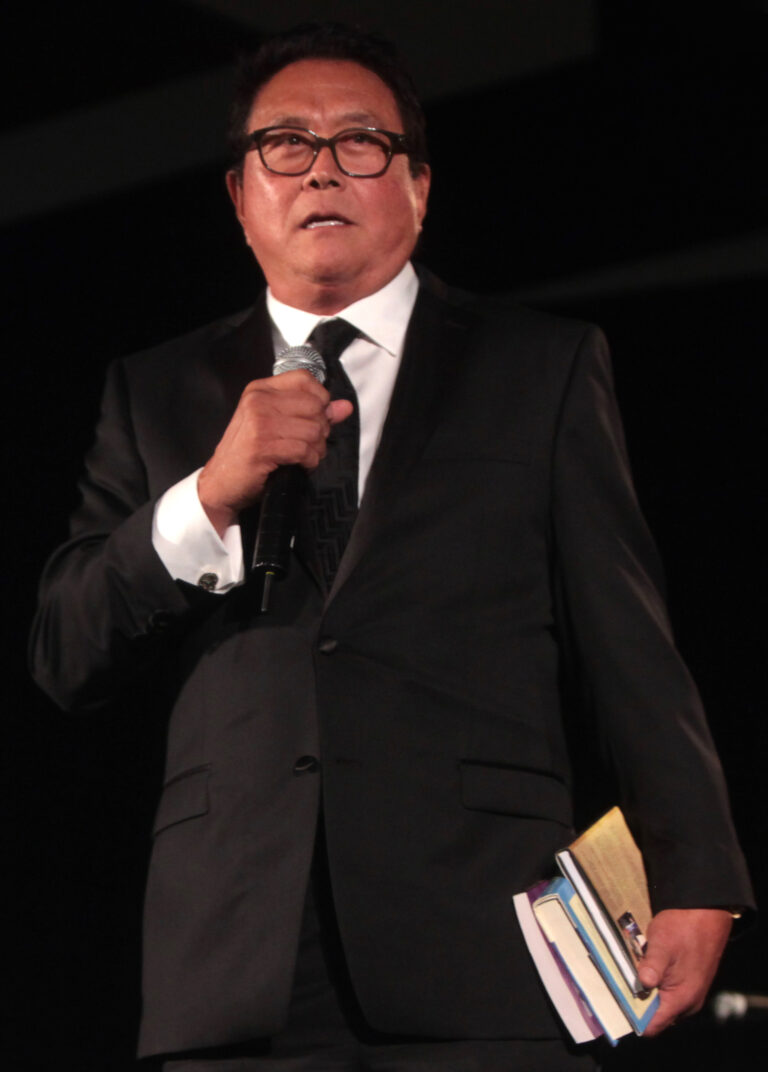
Source · CC BY-SA 3.0 · Displayed crop
The essentials
Celebrity Net Worth estimates $100 million, but no public balance sheet connects Kiyosaki’s companies, property interests, metals, cryptocurrency, cash and liabilities. [1]
The publicized $1.2 billion debt is collective borrowing tied to about 1,500 apartment units and multiple partners; Vanity Fair estimated Kiyosaki’s personal portion at roughly $30–60 million. [2]
A trustee’s final account records a $7.5 million settlement payment under Robert Kiyosaki’s name. The underlying Chapter 7 case belonged to Rich Global, LLC, not to him personally. [7]
The early years · The career · The money · Current work · Personal life
Robert Kiyosaki’s old article already contained unusually deep court research, but buried it in a long wall of text and paired it with invented annual earnings. This rebuild preserves the primary evidence, removes the fabricated ledger and adds the most consequential 2026 reporting about his debt and personal life.
A company judgment is not a personal bankruptcy. Collective mortgage debt is not one person’s unsecured liability, and seminar revenue is not author income. Net Worth VIP — methodology
01 / The breakthrough
Rich Dad Poor Dad turned a financial story into a global education brand
Kiyosaki was born in Hilo, attended the U.S. Merchant Marine Academy and served as a Marine Corps helicopter pilot. His official biography describes business attempts before the book that made him famous.
Rich Dad Poor Dad was first published in 1997. Its distinction between assets and liabilities became the center of a larger system of books, the CASHFLOW game, seminars, courses, podcasts and licensing.
The influence is easy to document; the private economics are harder. Book sales, licensing revenue and company turnover do not disclose Kiyosaki’s royalties, ownership percentages, distributions or taxes.
02 / The seminar machine
$437.8 million in customer cash was licensee revenue, not Kiyosaki’s income
Federal court findings show that the seminar operation collected $437.8 million from 2007 through 2010. Whitney Education Group and successor entities operated those events under license rather than Kiyosaki running them directly.
Rich Global received just under $45 million in royalties over the same period. That is company revenue across four years, before expenses, tax, ownership allocation and any distribution to Kiyosaki.
The distinction matters because the larger seminar figure is often repeated beside his name as if it flowed to him. The court record establishes brand scale and a royalty stream, while stopping well short of a personal balance sheet.
03 / The estimate
$100 million remains an outside estimate after the $1.2 billion headline is corrected
Celebrity Net Worth updated its estimate to $100 million in August 2026. It does not publish a complete asset ledger, debt schedule or ownership map, so the figure remains an attributed estimate.
Vanity Fair reported that Kiyosaki and other investors collectively carry about $1.2 billion of debt tied to roughly 1,500 apartment units. Kim Kiyosaki said Robert does not personally owe the headline amount; the article estimated his portion at about $30–60 million.
The report also quoted roughly $3 million in annual income. Income, debt principal, property value and net worth measure different things. Without each LLC’s asset value and Kiyosaki’s exact equity, the headline cannot be turned into a better point estimate.
The evidence, with its limits
| Source / measure | Public figure | What it establishes |
|---|---|---|
| Celebrity Net Worth | $100M | Current third-party estimate without a reproducible personal balance sheet. |
| Collective property debt | $1.2B | Debt across an investor group and about 1,500 units, not Kiyosaki’s personal obligation. |
| Estimated personal debt share | $30M–$60M | Vanity Fair inference from reported income; exact ownership and loan schedules remain private. |
| Seminar cash revenue, 2007–2010 | $437.8M | Licensee customer revenue, not Rich Global royalties or personal earnings. |
| Rich Global royalties, 2007–2010 | Under $45M | Company receipts before costs, tax and owner distributions. |
| Trustee settlement receipt | $7.5M | Recorded payment by Kiyosaki; neither current wealth nor admission of liability. |
04 / The bankruptcy record
Rich Global entered Chapter 7; Robert Kiyosaki did not
After a $23.69 million judgment, Rich Global, LLC filed Chapter 7 liquidation in August 2012 with about $1.79 million in assets and $25.92 million in liabilities. The filing was for the company, not Kiyosaki personally.
Its largest meaningful asset was a receivable from Robert and Kim Kiyosaki totaling about $1.78 million including interest. The trustee later sued the Kiyosakis and related entities, alleging alter-ego liability and fraudulent transfers.
The defendants settled without admitting liability. The final account records Robert Kiyosaki’s $7.5 million payment in 2019 and a $6.46 million distribution to Learning Annex in 2020. These are hard cash-flow facts, but they still do not value his holdings today.
05 / The person now
Kim remains his business partner after divorce; they have no children
Vanity Fair reported in August 2026 that Robert and Kim Kiyosaki are divorced while continuing to work together. Kim supplied the clarification behind the collective debt figure. No reliable current source confirms a new romantic partner.
Kim has said publicly that she and Robert have no children. That corrects generic biography pages that invent heirs or leave the question ambiguous.
Kiyosaki remains active through the Rich Dad Radio Show. A 2025 SEC filing also named him a Genius Group board advisor paid in Bitcoin; the filing confirms the role and payment form, but not the fee amount or current value.
Financial record
The money timeline
Genius Group appoints Kiyosaki as advisorCurrentNot disclosedDetails & source
Amount and context
Not disclosed · BTC
The SEC filing says advisory fees are payable in Bitcoin but does not state the amount.
Open source for Genius Group appoints Kiyosaki as advisor ↗Trustee records Kiyosaki settlement paymentSettlement$7.5MDetails & source
Amount and context
$7,500,000 · USD
The final account records the payment under Robert Kiyosaki’s name after defendants settled without admitting liability.
Open source for Trustee records Kiyosaki settlement payment ↗Rich Global files Chapter 7BankruptcyNot disclosedDetails & source
Amount and context
Not disclosed · USD
The company listed about $1.79 million in assets and $25.92 million in liabilities; this was not a personal bankruptcy.
Open source for Rich Global files Chapter 7 ↗Judgment entered against Rich GlobalLegal$23.69MDetails & source
Amount and context
$23,687,957.21 · USD
The judgment ran against Rich Global, LLC rather than Kiyosaki personally.
Open source for Judgment entered against Rich Global ↗Rich Dad Poor Dad is publishedCareerNot disclosedDetails & source
Amount and context
Not disclosed · USD
The book became the foundation of the Rich Dad education, media and licensing brand.
Open source for Rich Dad Poor Dad is published ↗Amounts describe different financial measures and retain their original currencies. They must not be added together as personal wealth. Our methodology.
Common questions
Questions, answered
What is Robert Kiyosaki’s net worth in 2026?
Celebrity Net Worth estimates $100 million. The figure is not backed by a public personal balance sheet, so Net Worth VIP presents it as an attributed third-party estimate rather than a verified total.
Is Robert Kiyosaki personally $1.2 billion in debt?
No. Vanity Fair reported that the $1.2 billion belongs to a group of property investors and is tied to about 1,500 apartment units. The article estimated Kiyosaki’s personal portion at roughly $30–60 million, while exact loan and ownership schedules remain private.
Did Robert Kiyosaki file for bankruptcy?
The documented 2012 Chapter 7 filing was for Rich Global, LLC, not for Kiyosaki personally. The company entered liquidation after a large judgment.
Are Robert and Kim Kiyosaki still married?
No. Vanity Fair reported in August 2026 that they are divorced, while Kim remains his business partner. No reliable source reviewed confirms a current romantic partner.
Does Robert Kiyosaki have children?
No. Kim Kiyosaki said in a joint interview that she and Robert do not have children.
Follow the evidenceSources & reading12 links
- Celebrity Net Worth — Robert Kiyosaki ↗
Current $100 million estimate, last updated August 28, 2026; also summarizes the newer debt reporting.
- Vanity Fair — the $1.2 billion debt claim ↗
August 2026 interview with Robert and Kim Kiyosaki on their divorce, collective property debt, apartment holdings and reported income.
- Rich Dad — Robert Kiyosaki biography ↗
Official biography for full name, Hilo upbringing, military service, Rich Dad Poor Dad and the company co-founded with Kim.
- Rich Dad Radio Show ↗
Current official episode feed, including September 2026 activity.
- Learning Annex v. Rich Global — findings ↗
Court findings for $437.8 million seminar cash revenue and just under $45 million in royalties paid to Rich Global from 2007–2010.
- Rich Global — Chapter 7 petition ↗
Primary filing showing company liquidation, assets, liabilities and the receivable from Robert and Kim Kiyosaki; not a personal bankruptcy.
- Rich Global trustee — final account ↗
Final account recording Robert Kiyosaki's $7.5 million settlement payment and the estate distribution.
- SEC — Genius Group appoints Kiyosaki ↗
September 2025 Form 6-K naming Kiyosaki a board advisor, with fees payable in Bitcoin.
- KITV — Diamond Head property ↗
Public-record-based report of the $2.75 million purchase and later listing prices.
- Network Magazine — Kim and Robert interview ↗
Joint interview in which Kim says that she and Robert have no children.
- Wikimedia Commons — Robert Kiyosaki portrait ↗
Gage Skidmore photograph from September 5, 2014; CC BY-SA 3.0.
- Net Worth VIP — methodology ↗
Why collective property debt, company revenue, royalties, settlement payments and personal net worth remain separate.