Net worth & personal profile
Al PacinoNet Worth
The $40 million estimate, his own $50 million loss account, Godfather contracts, four children and three current 2026 films.
Source: Celebrity Net Worth estimate. Not an independently verified personal balance sheet.
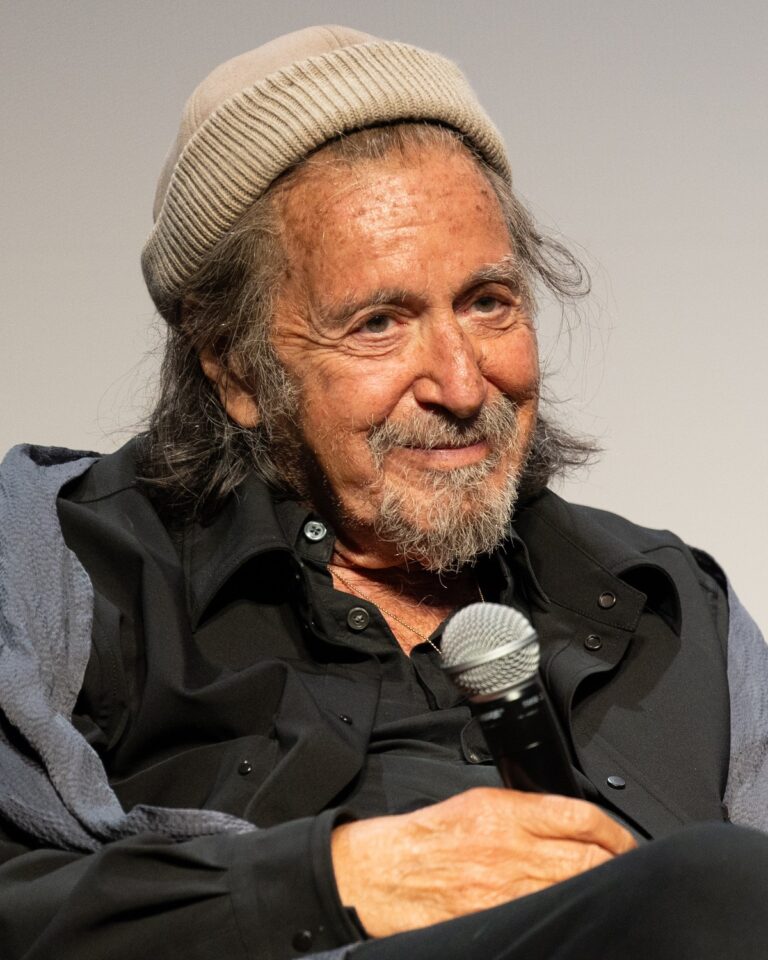
Source · CC BY-SA 4.0 · Displayed crop
The essentials
The current publisher estimate is $40 million; Pacino has not disclosed a current personal balance sheet. [1]
Pacino wrote that he once had $50 million and later had property but no liquid money, making any smooth lifetime-earnings model misleading. [4]
AFI records a $25,000 first-Godfather fee, $500,000 plus conditional participation for Part II and $8 million for Part III. [2]
Career · Love & family · Money · The evidence
Al Pacino’s old profile had a rare strength and a serious flaw: its AFI, court and Broadway research was much better than the average celebrity-wealth page, while the active fields still invented a $120 million career total split across film, television, real estate and “other.” Those buckets are now removed.
Celebrity Net Worth currently publishes $40 million. Pacino’s own memoir makes clear why that number cannot be reverse-engineered from film fees: he described moving from $50 million to having property but no liquid money, then returning to work. Celebrity Net Worth — Al Pacino · The Guardian — lessons from Sonny Boy · Net Worth VIP — methodology
01 / The breakthrough
A $25,000 role that changed the price of his work
Francis Ford Coppola’s insistence on casting Pacino as Michael Corleone created the breakthrough. AFI’s catalog cites contemporaneous trade reporting of $25,000 for The Godfather. Later retellings often use $35,000, but that figure is not as direct. American Film Institute — The Godfather
For Part II, the documented fee rose to $500,000 with five to ten percent of gross after a $25 million rental breakeven. Part III brought a reported $8 million plus $50,000 per day for reshoots. The clauses show bargaining power; without a participation statement, they still do not reveal final lifetime cash. American Film Institute — The Godfather · American Film Institute — The Godfather Part III
02 / Family
Four children, no marriage and a private present
Pacino has never married. CBS reported the 2023 birth of Roman with producer Noor Alfallah and names his three adult children: Julie Marie and twins Anton James and Olivia Rose. CBS News — Roman Pacino born
Public reporting has used both romantic and co-parenting language for Pacino and Alfallah. The reviewed current record does not settle a romantic label, so this profile names the confirmed family connection without inventing a present partner.
03 / The money story
A fortune lost, residuals retained and no clean balance sheet
In Sonny Boy, Pacino said he had $50 million and later had no liquid money, despite still owning property. His account includes extravagant overhead and a former money manager; the federal restitution docket concerns all victims and does not establish a $50 million Pacino-specific court award. The Guardian — lessons from Sonny Boy · CourtListener — SEC v. Starr
Pacino also wrote that Scarface residuals still support him. That is evidence of continuing catalog income, not a disclosed annual payment. Broadway offers another caution: Glengarry Glen Ross grossed $14,301,932, but a production gross pays the whole show and does not reveal the star’s share. The Guardian — lessons from Sonny Boy · Playbill — Glengarry Glen Ross
The evidence, with its limits
| Source / measure | Public figure | What it establishes |
|---|---|---|
| Celebrity Net Worth — Al Pacino | $40 million | Current publisher estimate without an audited personal balance sheet. |
| The Guardian — lessons from Sonny Boy | $50 million to no liquid money | Pacino’s memoir account of a historical collapse, not his current net worth. |
| American Film Institute — The Godfather | $25,000 / $500,000 | Reported Godfather I and II base fees; the sequel also had conditional participation. |
| American Film Institute — The Godfather Part III | $8 million | Reported Part III base fee, plus a daily reshoot term. |
| Playbill — Glengarry Glen Ross | $14,301,932 | Broadway production gross for Glengarry Glen Ross, not Pacino’s salary. |
04 / Now
Three 2026 releases show the work never stopped
Pacino told CBS in 2024 that he had six unreleased films and kept accepting smaller roles. By 2026, that pipeline was visible: Killing Castro premiered at Tribeca with Pacino as a CIA operative, and Paramount released By Any Means theatrically on September 4. CBS News — Pacino memoir interview · Tribeca Festival — Killing Castro · Paramount Pictures — By Any Means
Father Joe screened in the Venice festival program on September 10, with Pacino in the cast. These credits confirm current activity at age 86. None of the official film pages discloses his fee, backend or production investment. Venice Biennale — Father Joe
Financial record
The money timeline
Killing Castro premieres at TribecaCareerNot disclosedDetails & source
Amount and context
Not disclosed · USD
Pacino presents the film and appears in an up-to-date licensed portrait.
Open source for Killing Castro premieres at Tribeca ↗Publishes Sonny BoyCareerNot disclosedDetails & source
Amount and context
Not disclosed · USD
The memoir supplies Pacino’s own account of losing liquidity and returning to work.
Open source for Publishes Sonny Boy ↗Part III arrives with an $8 million feeSingle-project fees and prizes$8MDetails & source
Amount and context
$8,000,000 · USD
The reported contract also included $50,000 per reshoot day.
Open source for Part III arrives with an $8 million fee ↗Part II raises the base feeSingle-project fees and prizes$500,000Details & source
Amount and context
$500,000 · USD
AFI records $500,000 plus conditional gross participation after a rental breakeven.
Open source for Part II raises the base fee ↗The Godfather opensSingle-project fees and prizes$25,000Details & source
Amount and context
$25,000 · USD
The $25,000 role turns Michael Corleone into Pacino’s defining breakthrough.
Open source for The Godfather opens ↗Amounts describe different financial measures and retain their original currencies. They must not be added together as personal wealth. Our methodology.
Common questions
Questions, answered
What is Al Pacino’s net worth in 2026?
Al Pacino’s net worth is estimated at $40 million by Celebrity Net Worth. The figure is a publisher estimate and not an audited personal balance sheet.
Did Al Pacino really lose $50 million?
Pacino wrote that he went from having $50 million to having property but no liquid money. That is his account of a broader financial collapse, not a court finding or his current balance sheet.
How much was Al Pacino paid for The Godfather?
AFI cites a contemporaneous $25,000 fee for the first film. Part II brought a reported $500,000 base plus conditional participation, while Part III carried a reported $8 million base fee.
Does Al Pacino have a wife and children?
He has never married. He has four children: Julie Marie, twins Anton James and Olivia Rose, and Roman. No current romantic partner is reliably confirmed in the reviewed sources.
Is Al Pacino still acting?
Yes. Killing Castro premiered at Tribeca in June 2026, Paramount released By Any Means on September 4, and Father Joe screened at Venice on September 10.
Follow the evidenceSources & reading14 links
- Celebrity Net Worth — Al Pacino ↗
$40 million publisher estimate; no audited personal balance sheet.
- American Film Institute — The Godfather ↗
Contemporaneous trade figures: $25,000 first-film fee; $500,000 sequel fee plus conditional participation.
- American Film Institute — The Godfather Part III ↗
1990 trade report: $8 million fee plus $50,000 per reshoot day.
- The Guardian — lessons from Sonny Boy ↗
Memoir-based account of his $50 million-to-no-cash collapse and Scarface residuals.
- Penguin Random House — Sonny Boy ↗
Publisher page, 2026 paperback edition and career biography.
- CourtListener — SEC v. Starr ↗
Public docket for the former money manager’s case; restitution involved all victims, not a Pacino-only award.
- Playbill — Glengarry Glen Ross ↗
$14,301,932 Broadway production gross; Pacino’s compensation was not disclosed.
- CBS News — Roman Pacino born ↗
Representative-confirmed fourth child; names Julie Marie, twins Anton James and Olivia Rose, and Roman.
- CBS News — Pacino memoir interview ↗
Pacino says he keeps working and had six unreleased films in 2024.
- Tribeca Festival — Killing Castro ↗
Official 2026 festival listing and Pacino cast credit.
- Paramount Pictures — By Any Means ↗
Official September 4, 2026 theatrical page.
- Venice Biennale — Father Joe ↗
Official 2026 Venice program and Pacino cast credit.
- Wikimedia Commons — Al Pacino at Tribeca 2026 ↗
Jorge Jaramillo/JJxFile portrait licensed CC BY-SA 4.0.
- Net Worth VIP — methodology ↗
Why actor fees, production grosses, residuals and publisher estimates remain separate.