Net worth & personal profile
Spike LeeNet Worth
The $60M estimate tested against the one disclosed directing fee, four decades of private deals, New York property records — plus wife Tonya, children Satchel and Jackson, and his latest film.
Source: Celebrity Net Worth estimate. Not an independently verified personal balance sheet.
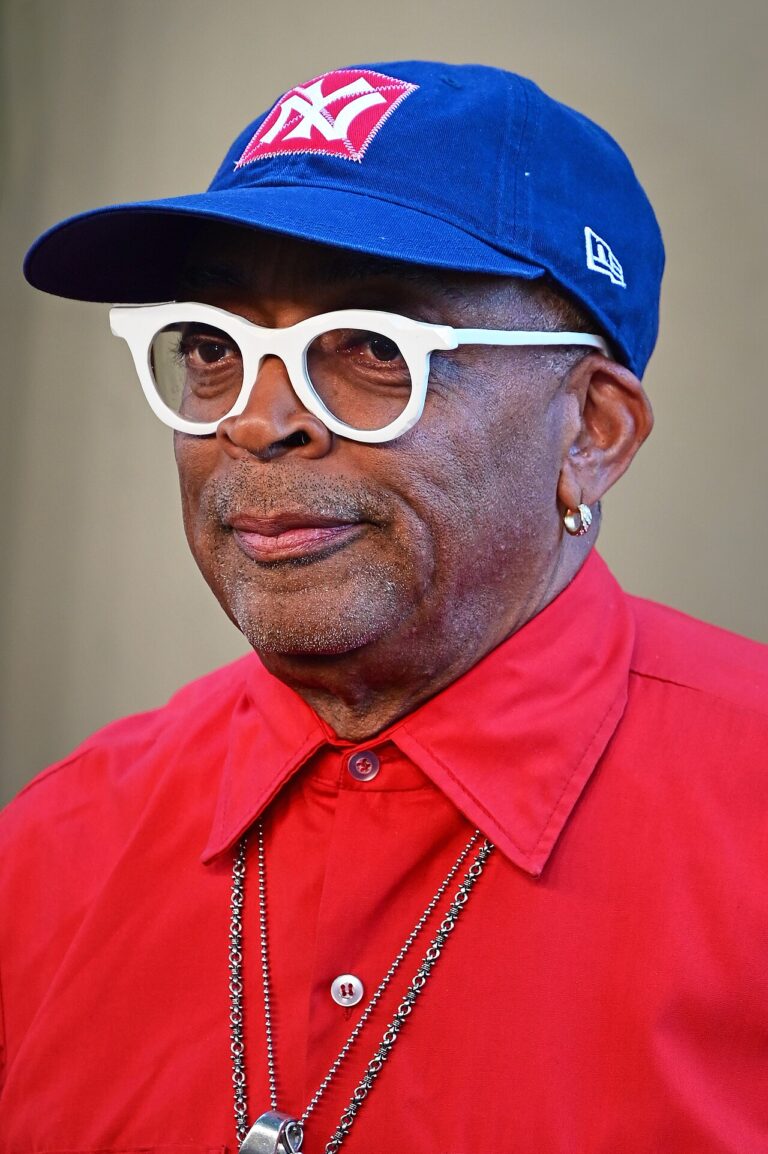
Source · CC BY-SA 4.0 · Displayed crop
The essentials
Celebrity Net Worth publishes $60 million, but no public balance sheet reproduces the figure. [1]
Lee disclosed a $3 million fee for Malcolm X and said he put $2 million back into the production — the only directing fee located in the public record. [2]
The $7.14 million box office for She’s Gotta Have It and the $2.4 million budget of Get on the Bus describe film economics, not Lee’s personal income. [3]
The early years · The career · The money · Current work · Personal life
The useful question is not whether a familiar $60 million number exists online. It is which parts of Spike Lee’s financial life can actually be documented. One directing fee, two independently financed productions, one early Nike payment, a cash prize and public property records provide real anchors; most later compensation remains private.
Box office belongs first to theaters and distributors, a film budget is production spending, and a mortgaged home is not worth its headline sale price to the owner. The profile follows the distinctions in the Net Worth VIP methodology.
01 / The breakthrough
A $175,000 independent film turned Lee into a bankable New York filmmaker
Lee studied at Morehouse College and earned an MFA from NYU Tisch. His thesis film won a Student Academy Award, establishing the craft before the commercial breakthrough.
She’s Gotta Have It was made for a reported $175,000 and grossed $7,137,502 domestically. That roughly 41-to-one box-office-to-budget ratio explains the industry impact, but theatrical gross was divided among exhibitors, distributors and other participants.
Do the Right Thing, Malcolm X, Inside Man and BlacKkKlansman built a four-decade career across writing, directing, producing, commercials and television. The Academy honored Lee in 2015, and BlacKkKlansman later brought his first competitive Oscar.
02 / The documented deals
Malcolm X reveals the only public directing fee — and why it surfaced
In May 1992, Lee publicly described a $3 million directing fee for Malcolm X and said he had put $2 million of it back into the production. The disclosure accompanied a fight over funding and creative control, which explains why this otherwise private contract term became public.
Lee named seven supporters who supplied money to finish the film: Bill Cosby, Oprah Winfrey, Michael Jordan, Magic Johnson, Janet Jackson, Prince and Peggy Cooper Cafritz. He described the money as gifts rather than loans or investments. The total was not disclosed.
Four years later, Get on the Bus was made for about $2.4 million with a group of Black investors that included Lee. The production budget establishes the scale of the project; it does not establish his individual contribution or return.
03 / The estimate
The $60 million figure is plausible context, not a public calculation
Celebrity Net Worth currently estimates $60 million. It does not publish the bank accounts, residuals, private-company ownership, tax history, property equity and liabilities needed to reproduce that figure.
The sparse disclosed payments show why invented career totals should be avoided. Boardroom reported $50,000 for the first Mars Blackmon commercial, but no complete value for the long Nike relationship is public. NYU confirms Lee’s tenured professorship and artistic-director role without disclosing salary.
Film receipts cannot fill the gap. A hit’s worldwide gross measures ticket sales, while the director’s compensation may combine a fee, bonuses and participation on undisclosed terms. The profile therefore retains the third-party estimate with an explicit confidence limit.
The evidence, with its limits
| Source / measure | Public figure | What it establishes |
|---|---|---|
| Celebrity Net Worth | $60M | Current third-party estimate without a reproducible asset-and-liability schedule. |
| Malcolm X directing fee | $3M | Lee’s disclosed fee; he said $2M went back into the production. |
| She’s Gotta Have It | $175K budget / $7.14M domestic gross | Breakthrough film economics, not Lee’s personal profit. |
| Get on the Bus | $2.4M budget | Investor-financed production scale; individual stakes and returns remain private. |
| First Nike/Mars Blackmon shoot | $50K | One early advertising payment, not the value of the whole Nike relationship. |
| Gish Prize | $300K | Documented cash award received in 2013. |
| Upper East Side townhouse | $16.6M reported purchase | Reported acquisition price; recorded financing must be deducted before discussing equity. |
04 / Property and business
The townhouse is still an asset, but debt prevents a simple equity claim
Lee and Tonya Lewis Lee acquired the Upper East Side townhouse from artist Jasper Johns in 1998. Press reports put the price at $16.6 million. The couple later marketed it for $32 million and then $28.5 million, but no later sale deed appears in the city index.
A 2025 consolidation agreement supports continued ownership. Earlier and later mortgages also show why an asking price cannot be treated as personal wealth: market value, outstanding principal, transaction costs and joint ownership all affect equity.
Lee’s production company, 40 Acres and a Mule Filmworks, remains based in Brooklyn. Its output and brand are visible, but no audited valuation or ownership transaction gives the company a defensible contribution to his net worth.
05 / The person now
Tonya, Satchel, Jackson, NYU and Highest 2 Lowest define the current profile
Lee has been married to producer, writer and attorney Tonya Lewis Lee since 1993. They have two adult children, Satchel and Jackson, both of whom work in creative fields. Current interviews continue to identify Tonya as his wife and production collaborator.
NYU lists Lee as a tenured professor, the Amy and Joseph Perella Chair and artistic director of Graduate Film. Teaching is therefore a continuing professional role, even though his compensation is not publicly itemized.
His latest released feature is Highest 2 Lowest, a New York reinterpretation of Akira Kurosawa’s High and Low starring Denzel Washington. Apple lists Lee as director and executive producer; the film began streaming globally in September 2025.
Financial record
The money timeline
Highest 2 Lowest begins global streamingCareerNot disclosedDetails & source
Amount and context
Not disclosed · USD
Apple lists Lee as director and executive producer; compensation terms were not disclosed.
Open source for Highest 2 Lowest begins global streaming ↗Lee and Tonya acquire the Manhattan townhouseAsset$16.6MDetails & source
Amount and context
$16,600,000 · USD
The press-reported price is gross property cost; public mortgages matter to equity.
Open source for Lee and Tonya acquire the Manhattan townhouse ↗Lee discloses his Malcolm X feeClassification pending$3MDetails & source
Amount and context
$3,000,000 · USD
Lee said he returned $2 million of the $3 million fee to the production.
Open source for Lee discloses his Malcolm X fee ↗First Mars Blackmon Nike shootClassification pending$50,000Details & source
Amount and context
$50,000 · USD
This is one disclosed early payment, not the value of the full Nike relationship.
Open source for First Mars Blackmon Nike shoot ↗She’s Gotta Have It becomes the breakthroughCareer$7.14MDetails & source
Amount and context
$7,137,502 · USD
The reported gross came from a film made for about $175,000; ticket sales were not Lee’s personal income.
Open source for She’s Gotta Have It becomes the breakthrough ↗Amounts describe different financial measures and retain their original currencies. They must not be added together as personal wealth. Our methodology.
Common questions
Questions, answered
What is Spike Lee’s net worth in 2026?
Celebrity Net Worth estimates $60 million. No public balance sheet independently reproduces that number, so it is presented as an attributed estimate.
How much was Spike Lee paid for Malcolm X?
Lee disclosed a $3 million directing fee in 1992 and said he put $2 million back into the production. It is the clearest public directing-fee figure from his career.
Who is Spike Lee’s wife?
Spike Lee has been married to producer, writer and attorney Tonya Lewis Lee since 1993. Current interviews and appearances continue to identify them as a couple.
Does Spike Lee have children?
Yes. Spike and Tonya Lewis Lee have two adult children, Satchel Lee and Jackson Lee, who both work in creative fields.
What is Spike Lee working on now?
His latest released feature is Highest 2 Lowest, starring Denzel Washington. NYU also continues to list him as a tenured professor and artistic director of its Graduate Film program.
Follow the evidenceSources & reading13 links
- Celebrity Net Worth — Spike Lee ↗
Current $60 million third-party estimate, last updated June 4, 2026.
- The New York Times — Money from Black celebrities saved Malcolm X ↗
Contemporaneous report of Lee’s $3 million directing fee, $2 million reinvestment and seven donors.
- Box Office Mojo — She’s Gotta Have It ↗
Reported $7,137,502 domestic gross for the independently financed debut.
- Christian Science Monitor — Get on the Bus ↗
Contemporaneous account of the $2.4 million budget and Black investor group.
- Boardroom — Mars Blackmon and Nike ↗
Reported $50,000 fee for Lee’s first Nike/Mars Blackmon commercial shoot.
- The Real Deal — Spike Lee townhouse listing ↗
Reported $16.6 million purchase and later $32 million/$28.5 million asking prices.
- NYC ACRIS property records ↗
Public deed and mortgage index used to check continued ownership and recorded financing.
- NYU Tisch — Spike Lee faculty profile ↗
Official current role, education, production company and filmography.
- Apple TV Press — Highest 2 Lowest ↗
Official release and production information for Lee’s latest feature.
- NPR/WJCT — Spike Lee on Highest 2 Lowest ↗
Interview confirming Tonya’s producing work and children Satchel and Jackson.
- Academy — Spike Lee ↗
Official biography, Student Academy Award and Honorary Academy Award context.
- Wikimedia Commons — Spike Lee portrait ↗
Philip Romano photograph from July 14, 2026, licensed CC BY-SA 4.0.
- Net Worth VIP — methodology ↗
Why box office, contract values, property prices and private wealth are kept separate.