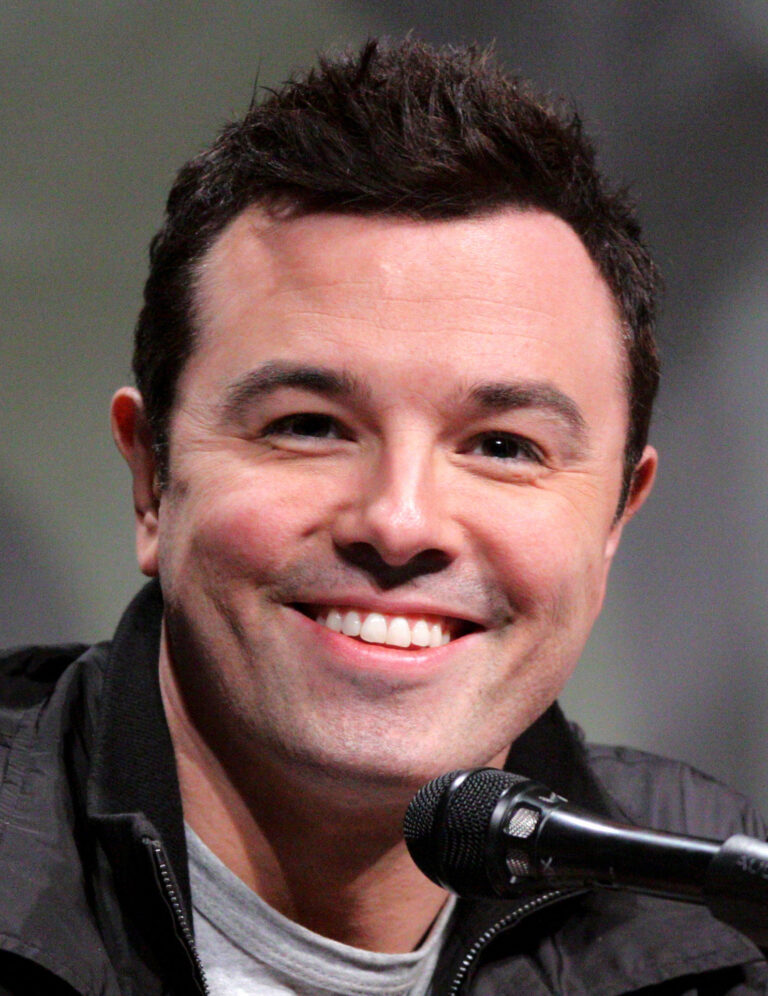
Every account of Seth MacFarlane’s wealth rests on one assumption: that he owns the series he created.
The copyright register says otherwise. Across every registration we checked for his three television series, a studio is recorded as both author and claimant — the signature of work made for hire. MacFarlane appears only as an author, never as an owner.
Of 175 registrations under his name, he is the claimant on exactly one — and it is a contribution to a book.
Seth MacFarlane Net Worth: Why We Publish No Figure
- Estimates run $300m to $400m — built on two contract figures that neither party ever confirmed
- Not one payment to him is documented — the only proven money moves outward
- Our take: no verified figure. His wealth is contractual, and contracts are not disclosable. See our methodology.
Who Actually Owns the Work
The register distinguishes two roles: the author who made a work, and the claimant who owns the copyright. For employees and contractors these separate.
| Work | Claimant |
|---|---|
| His three television series | A film studio — author and claimant |
| His 2012 feature | A distribution partnership |
| His 2011 album | A major record label |
| His recordings from 2021 onward | His own production company |
That last row is the real finding, and it is datable. His 2011 album belonged to the label. Every recording registered from July 2021 onward — six of them through January 2025 — is claimed by his own company.
Somewhere around 2020 he stopped handing his masters to a label and started keeping them. That is documented asset-building in his own name, and no wealth estimate anywhere mentions it.
The corollary matters too. Because he does not own the series, his money from them is contractual — fees and profit participations. And contracts carry no disclosure duty. That is why a wealth figure here is structurally impossible, not merely unverified.
The $100 Million Deal, in Its Own Words
The 2008 contract that made his reputation as television’s highest-paid creator is quoted everywhere as a fact. Here is what the original report actually says.
- The deal “could be worth more than $100 million” — conditional, not stated
- “Neither side would comment on the size of the deal”
- It “is said to” include advances against his back end — so not salary
- MacFarlane himself confirms no number, saying only that he is paid well
The report is dated 4 May 2008 and describes the term as running “through 2012.”
The most-cited estimate renders this as: “2009: five-year, $100 million deal, the largest television contract at the time.” Wrong year, an invented term length, and the conditional silently removed.
The 2020 successor deal is weaker still. The $200 million figure comes from “an individual with knowledge of the deal” — one anonymous source — and the company “declined to comment on the value of the deal.” Reporting elsewhere notes it includes a signing bonus and overhead for his production company. Company overhead is not personal income.
One precise, uncontested figure does sit in that same 2008 article, and nobody quotes it: around 1998 the studio gave him $50,000 to produce the presentation film for the series.
A Whiskey Stake, With a Complication
The most precise document in his file is a small one. A whiskey company raising money from the public in February 2026 had to file its full ownership table — and he is in it.
A holding company that MacFarlane signs for personally as manager holds 8,325 preferred units — 21.1% of that class, and 4.12% of total voting rights. The capital table records $499,500 against it, and the arithmetic checks exactly against the stated price per unit.
Two caveats, both from inside the same filing.
First, an earlier version of that very table shows $0 for the same units; the figure was added by a correction note. So $499,500 is a recorded subscription value, not proof that cash changed hands — and the units appear to have originated as consideration for an endorsement.
Second, and more striking: the campaign page in the same submission markets him as a “Founding Investor” — while another exhibit in that submission records the early termination of his agreements with the company. He still holds the units. The marketing and the legal document disagree, inside one filing.
$6,000,000 Out — the Best-Documented Money in His File
The only sums we can confirm were paid are ones he gave away, and they are documented by the recipients themselves rather than by press reports.
| 1 Aug 2023 | $1,000,000 | Emergency relief for industry workers |
| 21 Sep 2023 | $5,000,000 | Seeding a $10m matching initiative |
| 2018 | $2,500,000 | Public broadcasting — trade reports only, recipient page blocked |
A structural note on why this is one-directional: donor names and amounts are redacted in the public copies of charity tax filings. So a recipient’s own announcement is the only way such a gift becomes checkable — and a gift that goes unannounced is invisible by design, not by omission.
What the Corporate Filings Do and Don’t Say
The former parent’s annual report names his flagship series — descriptively, among top-rated comedies, with no figure attached.
But one phrase in that passage is revealing. The same paragraph flags a different show as “the FOX Entertainment-owned comedy” — explicitly distinguishing what the company owns from what it merely airs. His series is not in that category.
Meanwhile the studio’s current corporate owner mentions the series zero times across all its filings.
None of this is evidence about his pay — talent contracts are never a disclosable item, so silence there is exactly what you would expect. We report it because it shows where the asset sits, which is not with him.
Where the Big Numbers Come From
The most-cited $400 million estimate shows its working, and the working is a category error.
It cites franchise revenue of over $1 billion across syndication, home video and merchandising, plus $500 million in annual advertising, plus box office. Every one of those flows to a studio — the same studio the copyright register names as the owner.
His 2012 film took $549,368,315 worldwide against a $50 million budget. That is a fact about a film. His share of it is documented nowhere.
So the $400 million is: a conditional estimate from 2008, plus a single anonymous source from 2020, plus revenues belonging to somebody else.
What Could Not Be Established
His production company leaves no regulatory trace. A full-text search of securities filings returns zero for it — control-tested, since his personal name returns twelve hits and the series 260. Expected, but worth stating: the company through which he holds his masters is entirely private.
A 2014 copyright claim against him ended in March 2015 by joint stipulation, dismissed with prejudice. Settlement terms are not in the file, and under US practice would not be.
The archive he funded at a national library carries his name but no published sum.
Blocked, not empty: the entire trademark search layer is currently behind a bot challenge, so we cannot say whether his series marks are held by him, his company or the studio — an open question, not a negative finding. The state company register also refused access.
One limit on our own null result: no charitable foundation exists under his name — but that register indexes organisation names only, not officers. An unpaid board seat at someone else’s charity would not surface. We mark that inconclusive rather than negative.
The Bottom Line
Documented: $50,000 to make a pilot presentation in 1998. $6,000,000 given away in 2023. A 4.12% voting stake in a whiskey company, recorded at $499,500 and contested within its own filing. And a shift of his music masters into his own company from 2021.
Not documented: a single payment to him from the work that made him famous.
He does not own his series — the register is unambiguous. What he has is contracts, and the two numbers everyone quotes for those contracts were denied comment by the companies that signed them.
Sources
- The 2008 report: “could be worth” — and both sides declining to comment
- The 2020 figure: one anonymous source, company declined to comment
- The ownership table he signs for personally
- The offering statement: 8,325 units of 39,500
- “Founding Investor” — in the same submission as the termination
- $1,000,000, August 2023 — the recipient’s own announcement
- A further $5,000,000, September 2023
- The annual report that distinguishes what the company owns from what it airs
- $549,368,315 worldwide — a fact about a film, not a person
- A 2014 earnings estimate — annual income, not wealth
- $400 million, built on revenues that belong to a studio
Money Timeline
| Date | Type | Event | Amount | Details |
|---|---|---|---|---|
| 1998-06-01 | Payday | $50,000 to make the pilot presentation | $50K | A precise, uncontested figure that sits in the same 2008 trade article everyone quotes for the $100 million deal - and that nobody quotes. The studio gave him this much around 1998 to produce the presentation film for the series that would define his career. It is one of very few exact amounts in his file that is neither conditional nor anonymously sourced. source |
| 2008-05-04 | Deal | The $100 million that "could be worth" $100 million | The contract that made his reputation as television's highest-paid creator, quoted everywhere as fact. The original report says it could be worth more than $100 million - conditional - and states that neither side would comment on the size of the deal. It adds that the deal is said to include advances against his back end, so it is not salary, and MacFarlane himself confirms no number. The most-cited estimate renders this as a 2009 five-year deal: wrong year, invented term length, conditional removed. No amount is booked here because none was ever stated. source | |
| 2012-06-29 | Deal | $549,368,315 worldwide - a fact about a film, not a person | $549.4M | His 2012 feature against a $50 million production budget. It is box office gross, and the copyright register names a distribution partnership rather than him as the claimant of the work. His share of it is documented nowhere. We include it because the most-cited wealth estimate builds on figures exactly like this one - alongside franchise revenue of over $1 billion and $500 million in annual advertising, all of which flow to a studio. source |
| 2020-01-10 | Deal | $200 million, from one anonymous source | The successor deal, and weaker evidence than its predecessor. The figure comes from an individual with knowledge of the deal - a single unnamed source - and the company declined to comment on the value of the deal. Reporting elsewhere notes it includes a signing bonus and overhead for his production company. Company overhead is not personal income, and a multi-year contract volume is not a payment. source | |
| 2021-07-09 | Deal | His masters move from a label to his own company | The one documented shift in what he actually owns. His 2011 album is registered with a major label as claimant. From this date onward every recording of his that we found - six through January 2025 - is claimed by his own production company instead. Around 2020 he stopped handing his masters to a label and started keeping them. It is real, datable asset-building in his own name, and no wealth estimate mentions it. Set against this: across every registration for his three television series a studio is both author and claimant, and of 175 registrations under his name he is claimant on exactly one, a book contribution. source | |
| 2023-09-21 | Deal | $6,000,000 given away - the best-documented money in his file | $6M | One million on 1 August 2023 for emergency relief for industry workers, then five million on this date to seed a $10 million matching initiative - both figures from the recipient organisation's own announcements rather than from press reports. A further $2.5 million to public broadcasting in 2018 rests on trade reports only. There is a structural reason this only runs one way: donor names and amounts are redacted in public copies of charity tax filings, so a recipient's own announcement is the only route by which such a gift becomes checkable. A gift that goes unannounced is invisible by design. source |
| 2026-02-05 | Deal | $499,500 for 4.12% of a whiskey company - contested inside its own filing | $500K | A company raising money from the public had to file its full ownership table, and he is in it: a holding company he signs for personally as manager holds 8,325 preferred units, 21.1 per cent of that class and 4.12 per cent of total voting rights, with this sum recorded against it. Two caveats from inside the same filing. An earlier version of that very table shows $0 for the same units, with the figure added by correction note - so it is a recorded subscription value rather than proof cash changed hands, and the units appear to have originated as consideration for an endorsement. And the campaign page in the same submission markets him as a Founding Investor while another exhibit records the early termination of his agreements with the company. source |
| 2026-08-04 | Deal | $400 million, built on revenue belonging to a studio | The most-cited estimate shows its working, and the working is a category error: it cites franchise revenue of over $1 billion across syndication, home video and merchandising, plus $500 million in annual advertising, plus box office. Every one of those flows to the studio the copyright register names as the owner. What remains is a conditional estimate from 2008 and a single anonymous source from 2020. Meanwhile his production company returns zero hits in a full-text search of securities filings - control-tested, since his personal name returns twelve and the series 260. source |
Key financial events, aggregated from the sources cited above. See our methodology.
Frequently Asked Questions
Short answers to the most common questions about this profile. For our sourcing and update method, see our Methodology page.
What is Seth MacFarlane's net worth in 2026?
No verified figure exists, and here the impossibility is structural rather than accidental. Estimates run from $300 million to $400 million, built on two contract figures that neither signing party ever confirmed. The deeper problem is that he does not own the work: across every copyright registration checked for his three television series, a studio is recorded as both author and claimant, the signature of work made for hire, while MacFarlane appears only as an author. Of 175 registrations under his name he is claimant on exactly one, a contribution to a book. So his money from those series is contractual - fees and profit participations - and contracts carry no disclosure duty anywhere.
Did Seth MacFarlane get a $100 million deal from Fox in 2008?
That is a trade paper's estimate, not a confirmed payment. The original report of 4 May 2008 says the deal could be worth more than $100 million - conditional - and states in the same piece that neither side would comment on the size of the deal. It adds that the deal is said to include advances against his back end, so it is not salary. MacFarlane himself confirms no number. The most-cited estimate renders all this as a 2009 five-year $100 million deal: wrong year, an invented term length, and the conditional silently removed. The same 2008 article contains one precise, uncontested figure nobody quotes - around 1998 the studio gave him $50,000 to produce the presentation film for the series.
Does Seth MacFarlane own Family Guy?
No. In the US copyright registrations the Twentieth Century Fox Film Corporation is recorded as both author and claimant, which is what work made for hire looks like; MacFarlane appears in the author role only. The same pattern holds for his other two series, and his 2012 feature is claimed by a distribution partnership. There is a revealing corroboration in corporate filings: the former parent's annual report names the series descriptively among top-rated comedies, and in the same paragraph flags a different show as the FOX Entertainment-owned comedy - explicitly distinguishing what the company owns from what it merely airs. His series is not in that category.
Has Seth MacFarlane's ownership position ever changed?
Yes, in his music, and it is datable. His 2011 album is registered to a major record label as claimant. From July 2021 onward, every recording of his that we found - six of them through January 2025 - is claimed by his own production company instead. Somewhere around 2020 he stopped handing his masters to a label and started keeping them. That is documented asset-building in his own name, and no wealth estimate anywhere mentions it.
What has Seth MacFarlane actually been documented paying or receiving?
The only sums confirmed as paid are ones he gave away, and they are documented by the recipients themselves rather than by press reports: $1,000,000 on 1 August 2023 for emergency relief for industry workers, and a further $5,000,000 on 21 September 2023 seeding a $10 million matching initiative. A further $2.5 million to public broadcasting in 2018 rests on trade reports only. There is a structural reason this can only run one way: donor names and amounts are redacted in the public copies of charity tax filings, so a recipient's own announcement is the only route by which such a gift becomes checkable. Beyond that, one securities filing from February 2026 records a holding company he signs for personally holding 8,325 preferred units of a whiskey business - 21.1 per cent of that class and 4.12 per cent of total voting rights - with $499,500 recorded against it.
More hollywood profiles like this
Browse a curated selection of other hollywood profiles. Net-worth figures load when available; otherwise see the individual profile.