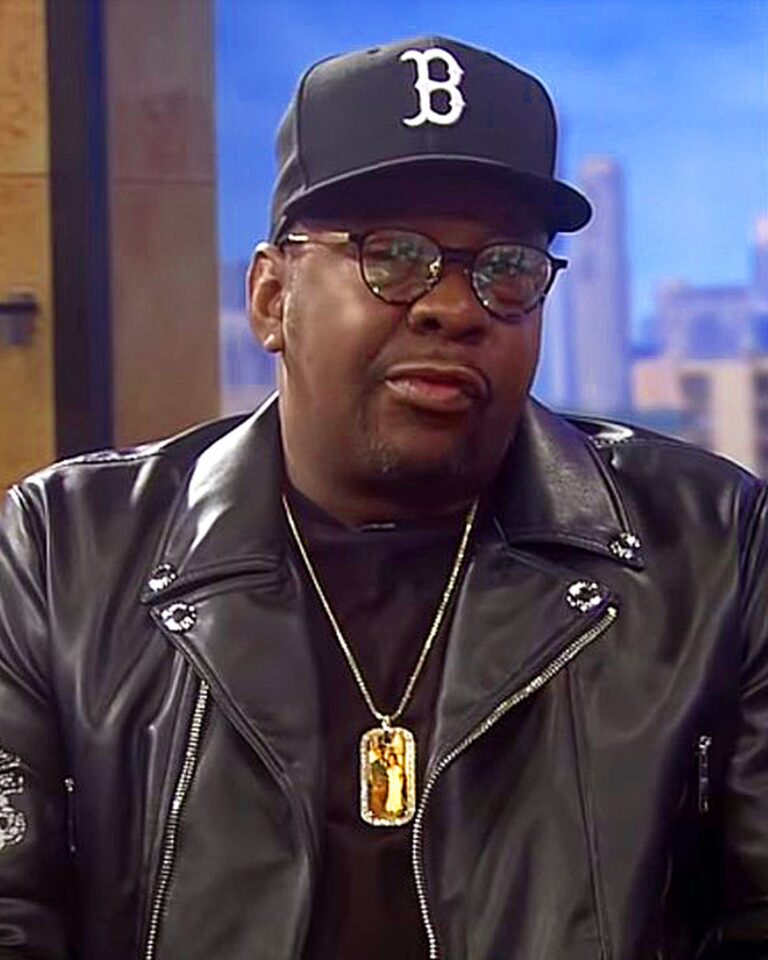
In 1999 a California court ordered 52 of Bobby Brown’s song copyrights — including My Prerogative and Humpin’ Around — assigned to a creditor. The order is filed in the federal copyright register, where anyone can read it.
We have not seen it referenced anywhere else.
Bobby Brown Net Worth: Why We Publish No Figure
- Every documented sum in his file is a liability or a loss — not one is an asset
- The two circulating figures differ by a factor of 13.5 and do not describe the same thing
- Our take: no verified figure. See our methodology.
The $1.87 Story Is Not a Court Finding
The most repeated fact about his early career: after the group’s first major tour, each member was handed a cheque for $1.87.
We went looking for the source. It traces to a 2015 book, and it reached mass audiences through a 2017 television dramatisation. There is no contemporaneous record of it from the 1980s.
What a court actually said is more revealing. In 1985, after a week of evidence, the federal appeals court wrote:
“The judicial record before us does not show whether in accordance with their employment contracts the plaintiffs have ever received and are currently receiving from Streetwise royalties on the records.”
The question was open in court, and no judgment ever closed it. So the $1.87 is the participants’ account, not an established fact — and we present it that way.
A related conflation worth clearing up: the group did win $500 at a Boston talent contest in 1981. They came second. That figure and the $1.87 are frequently mixed together.
What the Case Did Establish
The litigation itself is well documented, and the financial architecture is stark. From the 1986 judgment:
- Five individual contracts signed in late 1982, when all five were about 14 years old. Each assigned the exclusive right to the group’s name
- The label spent over $330,000 of its own money on one single, which sold over a million copies
- In November 1983 the five disaffirmed every contract on grounds of minority
- Payment for early performances is described in the judgment as being made “albeit in nominal amounts“
The court awarded the name to the five members. It did not award damages — the case was decided on trademark ownership, not compensation. The frequent claim that they sued and won a payout is not supported by any published decision.
52 Copyrights, Taken by Court Order
This is the hardest document in his file and it comes from an unusual register: the federal record of copyright transfers.
Recorded September 1999, executed April 1999: an assignment order from a California court, in favour of a tour-merchandising company, against Bobby Brown and Bobby Brown, Inc.
Its scope is listed as “King of stage & 51 other titles; musical compositions” — 52 registrations in total, among them My Prerogative, Humpin’ Around, Two Can Play That Game, Get Away and She Ain’t Worth It.
An assignment order is an enforcement tool. A creditor with an unpaid judgment obtains the debtor’s income-producing rights. The register does not state the amount owed, and the underlying case file is not available online.
What it establishes is unambiguous: at the height of the value of his catalogue, his own compositions were being used to satisfy a debt.
The Reality Show Contract Exists — and Has No Number
Filed as an exhibit in one of his own later lawsuits is the full March 2004 co-production agreement for the television series that made him a reality-TV figure. It is the kind of document that almost never becomes public.
The structure is fully specified: a 50/50 joint venture, with the partner funding 100 per cent of the initial investment, and revenue split equally only after that investment plus 10 per cent has been repaid. His acting and producing fees were expressly excluded from the split.
And here is the catch. A covering email describes the document as setting out his talent fee. The contract text contains no figure at all. We have the mechanism and not the money.
“No Money and No Assets” — In Open Court
In March 2006 a Massachusetts family court found him in contempt over child support. The documented figures:
- Arrears of $63,500
- An obligation of $5,500 a month, paid since the early 1990s, with payments stopping in May 2003
- His counsel’s statement in court: he had “no money and no assets” and was unemployed
He was sentenced to 90 days and served one night; the arrears were paid by others.
The same article is the origin of the other number attached to him — that he “reportedly earned $27 million between 1989 and 1993”. Note the hedge: the source flags it as reported, offers no derivation, and it describes earnings over four years, more than thirty years ago — followed, on the same page, by a court finding of no assets.
Two Estates, and What He Actually Received
Two probate matters dominate assumptions about his finances. Both are matters of public record, and we cover only their financial effect.
He inherited nothing from his former wife’s estate. Her will, signed in 1993, named their daughter as sole beneficiary. He appeared in it only as a contingent taker had there been no child — and the 2007 divorce made that clause inoperative.
The $36 million judgment is not his, and may be worth nothing. In November 2016 a Georgia court entered a default judgment of $36,251,918.50 in favour of his daughter’s estate. He is an heir to that estate. The judgment debtor died in 2020, and we found no public evidence that any part of it was ever collected.
A large judgment against an insolvent estate is a claim, not money. Any figure that folds it in is counting something that has not been shown to exist.
Two Lawsuits He Brought, Neither Producing Anything
- 2017: a claim stating damages “in excess of $1,000,000”. Closed within two months, no award visible in the record
- 2018: a claim over $2 million concerning unauthorised footage. Dismissed in August 2019 — the publicity claims barred by the First Amendment
Claimed: over $3 million. Documented recovery: nothing.
The Catalogue Sale That Was Not His
In October 2020 a listed music fund acquired a catalogue including Every Little Step, Don’t Be Cruel and Roni. It is routinely read as Bobby Brown selling his songs.
The seller was the producer, L.A. Reid — selling his own writer’s share across 162 songs. Different person, different rights, price undisclosed.
On his own rights, he said in April 2025 that he now owns his masters. That is a podcast statement with no date and no document. We checked the copyright register for a formal reversion in his name and found none — he appears there only as a co-author named inside somebody else’s termination notice. The register neither confirms nor contradicts him.
A Tour Gross That Belongs to Nine People
A 2022 tour took $37,119,930 across 30 shows.
That is gross ticket revenue for a package tour carrying three separate acts, one of which has six members. Out of it come venue costs, the promoter’s share, production, crew, management and agency — and what remains is divided among all of them. It says nothing whatever about his income.
Why the Searches Come Up Empty
Two negative results here look meaningful and are not.
The federal case database returns 87 matches for his name — every one a different person’s bankruptcy. But the four courts that matter for his file are all state courts, in Massachusetts, Georgia and California. That database does not cover state courts at all, and its federal coverage is partial and barely reaches before 1990. An empty result there means almost nothing.
Securities filings return 131 matches for his name, and one for the singer — a passing mention in a manager’s biography. Everything else belongs to an actress with a similar name, a company director, and various unrelated people. And that database starts in 2001, so the 1980s recording contracts are outside it entirely.
The trademark registers were inaccessible — authentication errors and bot blocks on every route. That is a locked door, not an empty room.
The Bottom Line
Look at what is actually documented: contracts signed at fourteen and disaffirmed at fifteen; a court that could not establish whether royalties were ever paid; 52 compositions assigned away to satisfy a debt; $63,500 in arrears and a declaration of no assets; two dismissed claims; an inheritance that produced nothing; a judgment that appears uncollected.
There is not one documented asset in the entire file.
Against that, the published estimates offer $2 million with no calculation, and $27 million in earnings that its own source marks as reported. A factor of 13.5, and the two figures do not even measure the same thing — one claims wealth today, the other income in four years of the early nineties.
You cannot compute a position from a ledger with only one column filled in.
Sources
- The 1999 assignment order covering 52 compositions
- The 1985 appeal: the record does not show whether royalties were received
- The 1986 judgment awarding the group’s name to its members
- The 2004 television contract, filed as a court exhibit
- The 2006 contempt finding, and the “reportedly $27 million”
- The will that left him nothing
- The $36,251,918.50 judgment — to an estate, not to him
- His $2 million claim, dismissed in 2019
- The 2020 catalogue deal — the producer’s share, not his
- A $37.1 million tour gross, shared across three acts
- His 2025 statement about owning his masters
- The $2 million estimate, with no basis given
Money Timeline
| Date | Type | Event | Amount | Details |
|---|---|---|---|---|
| 1985-05-08 | Lawsuit | A court that could not establish whether royalties were ever paid | After a week of evidence the federal appeals court wrote that the judicial record before it does not show whether the plaintiffs have ever received and are currently receiving royalties on the records. That question was open in court and no judgment ever closed it - which is why the famous $1.87 per member is the participants' account rather than an established fact. It traces to a 2015 book and reached mass audiences through a 2017 dramatisation, with no contemporaneous record from the 1980s. Often conflated with a separate figure: the group won $500 at a Boston talent contest in 1981, coming second. source | |
| 1986-06-11 | Lawsuit | Contracts signed at 14, disaffirmed at 15 - and no damages | $330K | The judgment awarding the group's name to its five members. The figure here is what the label spent of its own money promoting one single, which sold over a million copies. The financial architecture is stark: five individual contracts signed in late 1982 when all five were about 14, each assigning the exclusive right to the group's name, all disaffirmed on grounds of minority in November 1983. Payment for early performances is described in the judgment as being made albeit in nominal amounts. The case was decided on trademark ownership - no damages were awarded, contrary to the common retelling. source |
| 1999-04-27 | Lawsuit | 52 of his song copyrights assigned to a creditor by court order | The hardest document in his file, from an unusual register - the federal record of copyright transfers. A California court ordered rights in 52 composition registrations assigned to a tour-merchandising company as creditor, against him and his company. The listed scope covers King of Stage and 51 other titles, among them My Prerogative, Humpin' Around and Two Can Play That Game. An assignment order is an enforcement tool: a creditor with an unpaid judgment takes the debtor's income-producing rights. The register does not state the amount owed and the case file is not online. At the height of his catalogue's value, his own compositions were being used to satisfy a debt. source | |
| 2004-03-25 | Deal | The television contract exists - and contains no figure | Filed as an exhibit in one of his own later lawsuits, the full co-production agreement for the reality series - the kind of document that almost never becomes public. The structure is fully specified: a 50/50 joint venture, the partner funding 100 per cent of the initial investment, revenue split equally only after that investment plus 10 per cent has been repaid, with his acting and producing fees expressly excluded from the split. A covering email describes the document as setting out his talent fee. The contract text contains no figure at all. We have the mechanism and not the money. source | |
| 2006-03-24 | Lawsuit | $63,500 in arrears - and no money and no assets, in open court | $64K | A Massachusetts family court found him in contempt over child support. The obligation was $5,500 a month, paid since the early 1990s, with payments stopping in May 2003. His counsel stated in court that he had no money and no assets and was unemployed. He was sentenced to 90 days, served one night, and the arrears were paid by others. The same report is the origin of the other figure attached to him - that he reportedly earned $27 million between 1989 and 1993, hedged as reported in the source itself, with no derivation, describing earnings over four years three decades earlier. source |
| 2016-11-17 | Lawsuit | $36,251,918.50 awarded - to an estate, and apparently never collected | $36.3M | A Georgia court entered this default judgment in favour of his daughter's estate, of which he is an heir. The judgment debtor died in 2020, and we found no public evidence that any part of it was ever collected. A large judgment against an insolvent estate is a claim, not money - any figure that folds it in is counting something not shown to exist. Separately, he inherited nothing from his former wife's estate: her 1993 will named their daughter as sole beneficiary and his contingent clause was made inoperative by the 2007 divorce. source |
| 2019-08-02 | Lawsuit | Over $3 million claimed across two lawsuits - nothing recovered | $2M | A claim over unauthorised footage was dismissed, the publicity claims barred by the First Amendment. An earlier action in 2017 stating damages in excess of $1,000,000 closed within two months with no award visible in the record. Claimed across both: over $3 million. Documented recovery: nothing. source |
| 2022-04-10 | Tour | $37,119,930 gross - shared across three acts and nine performers | $37.1M | Thirty shows, 330,270 tickets. This is gross ticket revenue for a package tour carrying three separate acts, one of them a six-member group. Out of it come venue costs, the promoter's share, production, crew, management and agency, and what remains is divided among all of them. It says nothing whatever about his income - and it is exactly the kind of headline figure that gets absorbed into wealth estimates. source |
Key financial events, aggregated from the sources cited above. See our methodology.
Frequently Asked Questions
Short answers to the most common questions about this profile. For our sourcing and update method, see our Methodology page.
What is Bobby Brown's net worth in 2026?
No verified figure exists, and there is not one documented asset in his entire public file - every sum we could establish is a liability or a loss. The published estimates give $2 million with no calculation shown, alongside a widely repeated $27 million in earnings between 1989 and 1993 that its own source marks as reported. Those differ by a factor of 13.5 and do not measure the same thing: one claims wealth today, the other income across four years of the early nineties, followed on the same page by a court finding that he had no assets.
Did New Edition really only get $1.87 each?
That is the participants' account rather than an established fact. It traces to a 2015 book and reached mass audiences through a 2017 television dramatisation, and there is no contemporaneous record of it from the 1980s. What a court actually said is more revealing: in 1985, after a week of evidence, the federal appeals court wrote that the judicial record before it does not show whether the plaintiffs ever received or were then receiving royalties. The question was open in court and no judgment ever closed it. A related conflation worth clearing up: the group did win $500 at a Boston talent contest in 1981, where they came second - that figure and the $1.87 are frequently mixed together.
Did Bobby Brown lose the rights to his own songs?
Yes, and it is documented in the federal copyright register. An assignment order from a California court, executed in April 1999 and recorded that September, transferred rights in 52 composition registrations to a tour-merchandising company as creditor, against Bobby Brown and Bobby Brown, Inc. The listed scope covers King of Stage and 51 other titles, among them My Prerogative, Humpin' Around, Two Can Play That Game and Get Away. An assignment order is an enforcement tool - a creditor with an unpaid judgment obtains the debtor's income-producing rights. The register does not state the amount owed, and the underlying case file is not available online.
What did Bobby Brown inherit from Whitney Houston?
Nothing. Her will, signed in 1993, named their daughter as sole beneficiary, and he appeared in it only as a contingent taker had there been no child - a clause the 2007 divorce made inoperative. Separately, a Georgia court entered a default judgment of $36,251,918.50 in November 2016 in favour of his daughter's estate, of which he is an heir. But the judgment debtor died in 2020 and we found no public evidence that any part of it was ever collected. A large judgment against an insolvent estate is a claim rather than money, and any net worth figure that folds it in is counting something not shown to exist.
Did Bobby Brown sell his music catalogue?
No sale of his has been documented, and one common misreading needs clearing up. In October 2020 a listed music fund acquired a catalogue including Every Little Step, Don't Be Cruel and Roni - but the seller was the producer L.A. Reid, selling his own writer's share across 162 songs, at an undisclosed price. Different person, different rights. On his own position, he said in April 2025 that he now owns his masters; that is a podcast statement with no date and no document. We checked the copyright register for a formal reversion in his name and found none - he appears there only as a co-author named inside somebody else's termination notice. The register neither confirms nor contradicts him.
More music profiles like this
Browse a curated selection of other music profiles. Net-worth figures load when available; otherwise see the individual profile.